The Art of a Confession: Quinn Patella

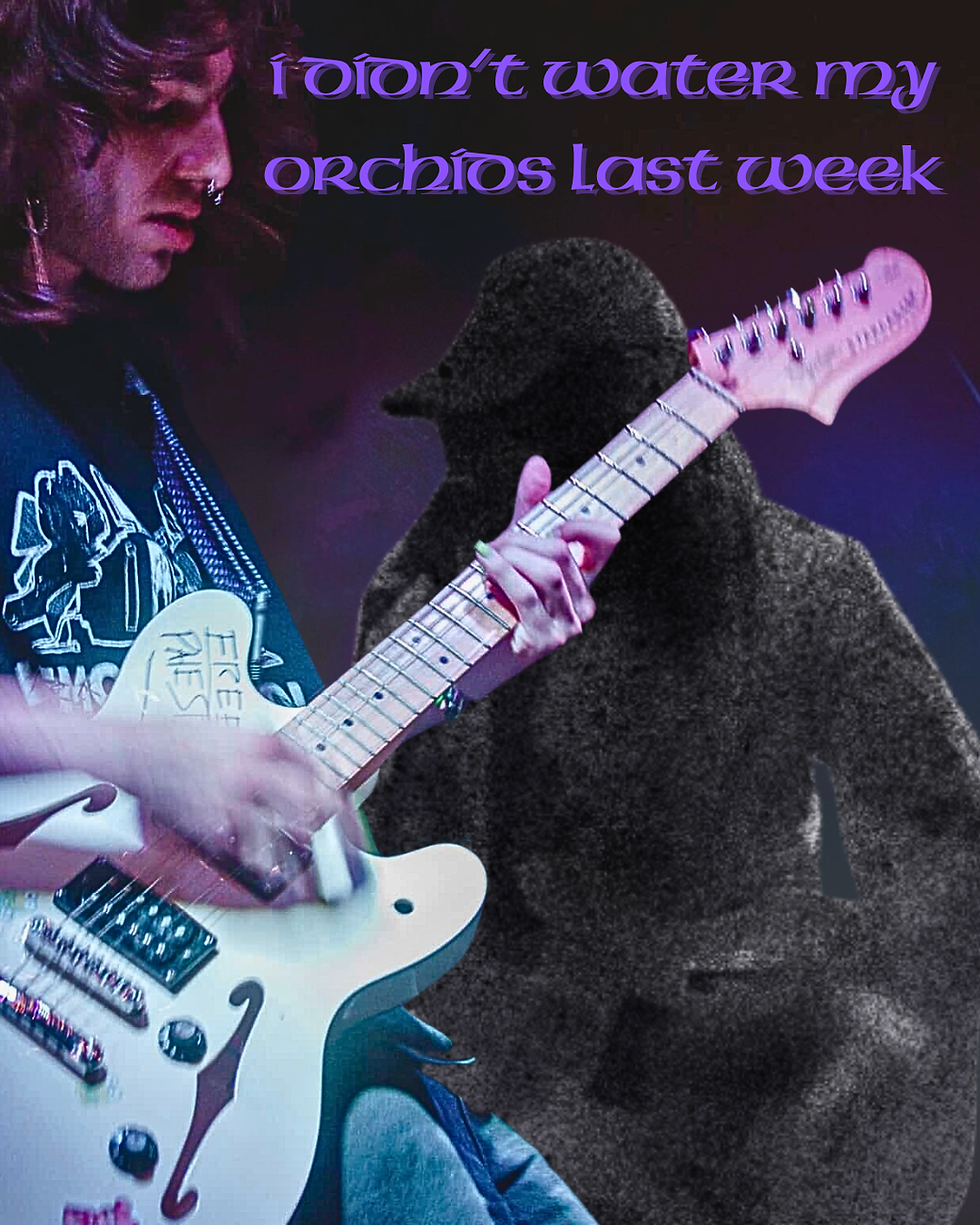
Quinn Patella has mastered the art of a confession. Their devotion to their musical project, i didn’t water my orchids last week, exists out of a raw, introspective, and brutal instinct to tell their story. Patella has not always been apt to wearing their heart on their sleeve within their music, though. Their first musical project, a casual high school band named After School Distraction, was Patella’s introduction to the DIY scene.“I was hitting up my friend from work and being like, ‘Hey, do you want to drum for me?’ [...] people are outside of these [DIY] scenes and they see it as some impossible task,” they said. “All that it is, is just asking. When you’re starting out you have nothing to lose.” Playing alongside small bands on punk bills throughout the Lehigh Valley, Patella felt the need to uncover a deeper honesty within their music. With voice recordings of scrapped guitar chords and ambient lo-fi sounds crafted for Dungeons & Dragons, Patella found a new project emerging: telling the truth. “That remains the basis of it, where it’s always been. I want to be transparent,” Patella said.
Instead of falling into the Midwest emo stereotype of cursing the world and praising oneself, the orchids project tackles both the good and bad in finding identity and coping with trauma and loss. They said, “I’ve always been fond of that form of writing where it’s not hiding something [...] It’s a queer voice singing about trauma because I don’t think we talk about that enough. When we do, we romanticize it.” Being a queer artist in Eastern Pennsylvania harbors a divisive nature around androgyny and expression. During Patella’s After School Distraction days, they felt they were not coming clean about who they truly were. “I could see the little tidbits of who I am now, I just didn’t know how to express it,” they said.

Being affiliated with other punk bands, there was always pushback to the way Patella presented themself. The punk scene of today has devolved from its roots within its politics, diversity, and the commercialization of the aesthetic. According to Patella, “You’d always hear in their voice that tinge of judgment about how you look, how you talk, the words you are singing, and I used to be so insecure about that.” Orchids is a project that allows Patella to be unabashedly themself, and to be a voice for other queer artists and music listeners. “I’ll be on stage singing the songs I wrote when I was seventeen very fucking depressed. There’s people that are listening to that and appreciate it [...] I wanted people to see my art like that,” Patella said.
Through Patella’s confessions, they have built a community within Lehigh Valley’s unconventional DIY music scene and beyond. From skate parks to discord chats, a conglomerate of music tastes and communities merge to support one another. At a skate park gig last summer, Patella felt a shift in how underground music scenes were being perceived by the wider audience. They said, “I go to [the skatepark] and I associate them with music not skating. They represent a mecca where everyone gets along.” Audiences of all different communities look for a newness: “It’s cool seeing that a lot of people will come from different genres. They don’t want the same shit [...] If a bill was stacked with the same genre, no one would come,” Patella said.

Patella also gained community through a DIY music collective based in Seattle, Washington called Friend’s House Records. Patella was initiated into this group via a discord server in which they met like-minded musicians all striving to make something of their art. Starting out as a group of friends, the collective started to grow, giving Patella a jumping off point to release their first orchids album. They said, “I was lucky enough because I didn’t have to do all that hard promo for a listener base. I got one right away because I had that group.” Not only does this group help promote each other’s works, but also aid in each other’s recording processes.
Friend’s House Records represents musicians all over the globe, allowing for a unique recording experience. Patella said, “Everyone will help each other. We have a group chat, and you message ‘Hey can someone record guitar for me?’ ‘Does anyone know how to play violin?’” Despite occasionally having the chance to record with others in person, Patella still believes that an artist does not need a studio to make good art; As they put it, “ [...] that’s the beautiful thing about DIY—there’s a misconception that you need to record in the studio to make it sound good. I’ve recorded in the worst areas; I’ve recorded on an old tape recorder, recorded outside, I’ve recorded in a bathroom.” Not only does this approach result in good art, but it adds an essence of intimacy within the tracks. Patella cites Starry Cat’s self-titled album as a prime example of this. “Sam Ray would record it on a boombox, and part of that boombox adds to it where you feel like you’re in the room. There’s always this sizzle in the back, and there’s that added aspect where the machine is also an instrument,” they said.
Patella is brutally barren on the i didn’t water my orchids last week’s project; the albums are conceptualized to be categories of Patella’s life. Their second album until it gets bitter is a soundscape of vocalized grief and anger that never gets resolved by the end of its runtime. Patella’s philosophy of this project was to illustrate stages of a breakup realistically. They said, “If you look at breakup albums, there’s always an ending of acceptance. I think that’s bullshit because no one’s gone through a breakup where they’ve gotten to that point right away. It takes years.” The album ends with anger, not acceptance—not only for the love lost, but for the time put into until it gets bitter. “I had to give myself a date because it was at the point where I was postponing my own grief,” Patella said.

Patella has had to grapple with their listeners finding solace within their music. “These are very personal things you’ve been through. You have these people that relate to it, and on one side you’re very happy they relate to it, but on the other you feel exposed.” Making confessional music, there is a push and pull between artist and audience, which is rewarding and needed within underground music spaces. Patella said, “It haunts you when you are holding that art. If I make a song that fucking hurts for me to make, and it means something to one person, fuck it, I did a good job.”
Patella is set to release Purity Amongst Flowers, their third and final album in their ‘sweetness trilogy,’ on March 27th. In this album, Patella zooms in on themes of adulthood, living with Complex Post-Traumatic Stress Disorder (CPSTD), and gender identity. They said, “When I was younger I found it insanely easy to let what hurt continue to plague me, and I’d just lock myself in my room and make music.” Latching onto hope, Patella continues this confessional project while pursuing their education, maintaining relationships, and growing up. “I want to move on to writing about different things rather than traumas from my youth, this is pretty much a fond farewell to that horrible period of my life.” Through this Patella continues to reach new listeners that connect with their stripped-down style and an emotional honesty that is distinct within the underground music scene.


Comments