Summer, 2022: A young musician, Dina Pfeffer, logs onto a Zoom call. This wasn’t a boring meeting, nor a tedious summer class— it was an open mic night, hosted by Club Passim, through video chat.

It was a Zoom call that would change the trajectory of their life.
After the show, the organizers of Club Passim reached out to Pfeffer, asking if they would be interested in performing at the club’s Campfire Festival.
“I freaked out. I had never had a real gig before that I hadn't organized myself. So, I played one of their songwriter rounds,” Pfeffer explained.
After the gig, as Pfeffer was packing up backstage, two people came up to them.
“They were like, ‘Hey, we really like your set. We're a drummer and a bassist. Do you want to be in a band?’ They basically just dropped out of the sky,” Pfeffer exclaimed. They were the future members of Good Judgement, Maddy Hill and Finn Altschuler.
Pfeffer immediately said they would love to. However, there was one issue– they were about to move to New York for college. They vowed to keep in touch.
A year and a half later, while Pfeffer was taking a break from college, they reached out once again. This time, it was them asking to be in a band.
Just like that, Good Judgement was born.









Good Judgement’s debut album, Cradle Your Head, pulls from a variety of ’90s references. As Pfeffer explained, “When I did write the majority of the material, I was really, really steeped in like ’90s rock and the riot grrrl sound. I loved Slater Kenny… I was really, really inspired by Liz Phair and her really droll confessional lyrical style, but also her guitar riffs. Also, people like The Breeders and The Pixies, just rock bands doing their their alt-rock thing.”
Pfeffer is a rolodex of ’90s knowledge, and it shows on Cradle Your Head. The album manages to mesh together a wide range of ’90s references, from its witty lyrical style reminiscent of Ani DiFranco or Liz Phair, to its eccentric guitar riffs.
“Honestly, a big experience on my songwriting in my younger years, the work of Ani DiFranco. She is like my number one icon, my number one songwriting inspiration. I learned about her from my mom. Shout out. She would play Ani DiFranco CDs for me in the car when I was younger,” Pfeffer detailed.
Pfeffer’s love of the ’90s even influenced how the album was recorded. They wanted Cradle Your Head to sound like it was being played live in studio, similar to some of their favorite ’90s albums.
“Obviously, there is production and mixing in all of these records, but you're not hearing the artifice. What I didn't want that some contemporary records have is the sound of Ableton— the sound of like the mixing engineers,” they explained.
“I really do think the production choices, or rather the capacity that these artists would have had to not necessarily produce their albums as highly, made me connect with the music more than the work of other great songwriters who do have a more polished sound,” they added.
The album was recorded over the course of several months in various apartments and homes. “We live tracked the drums and bass and guitar over a period of maybe two or three days,” Pfeffer recalled. “My friend Aiden who engineered the album, he recorded a lot of the vocals in his apartment, and then Finn who mixed most of the album also recorded some vocals at his place. It was really like a hodgepodge,” they said.



Equipped with some spare cash courtesy of a grant from the Iguana Fund, which is awarded to up and coming artists in the New England area, Good Judgement set out to record their first album in January 2025. Pfeffer had already been working on new material, but as they put it, “We went back to do the whole rock band thing and we recorded.”
Pfeffer wrote the songs that would eventually appear on Cradle Your Head over the course of a six-year period, on and off, before they even knew they would be in a band. The album's oldest song, “Cleo,” was written when Pfeffer was just fifteen.
“I didn't bring it to Good Judgement for a bit. We played our first few gigs without it,” they recalled. “I introduced a new batch of songs, and the band really liked Cleo the best, which really surprised me. I was like, ‘I'm not going to bring you guys material from when I was 15, I'm going to bring you guys songs that are more recent.’ But, I don't know. It just stuck.”
Despite “Cleo” being an older song, it still rings true for Pfeffer.
“I have a big fear that I'm trying to let up on a little bit of using cliches or using them ineffectively. There's a line in 'Cleo,' ‘All my metaphors sound cliche, I need more urgency in my poetry.’ I think it’s funny looking back that I wrote that when I was fifteen when I was really just starting out on my craft […] That's sort of been like a mission statement, I guess. I think I just really strive for my songs to be interesting. I think there's a lot of boring music out there and I would be disappointed in myself if I wrote something that I found boring,” Pfeffer explained.

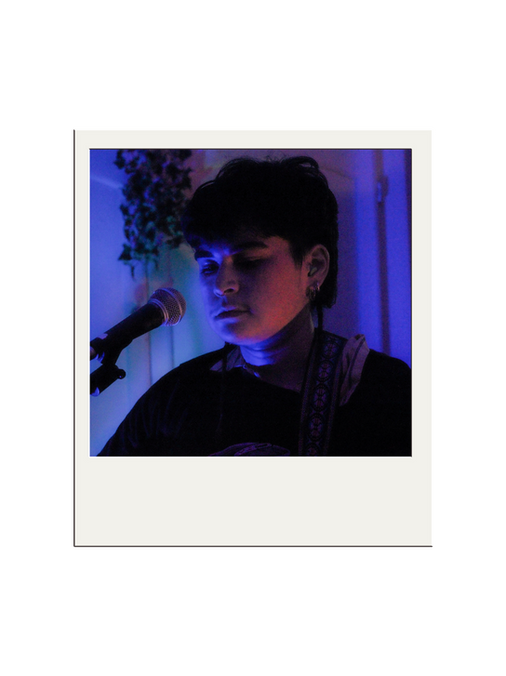
In the future, Pfeffer sees the sound of Good Judgement shifting. “Right now I'm really into traditional folk music,” they noted. They’ve already written a second album that adopts a more stripped down sound, mostly played on acoustic guitar and upright bass. Soon, they’ll be back in the studio to record it.
“I think the core of Good Judgment, and what I want to do with this band, is writing really good, meaningful songs, whatever they sound like. Whatever genre dressings they have,” they explained. “It’s all about finding the perfect melodic line to match the words and to match the mood. That unity of sound and meaning, when it works, is so beautiful.”
As they gear up to work on their next LP, Pfeffer shows no signs of slowing down.
“I would love to do this as my life's work. I know that's really hard to do, but that's the path I’m trying to be on,” they declared.
Good Judgement at their Boston album release party. Photo Sean Perry.
Good Judgement at their Boston album release party. Photo Sean Perry.